

Our Mission
  • To Succeed. Our success is based on your success.
  • [vc_separator type='transparent' color='' thickness='' up='20' down='7']
    Our Goal
    • To be successful in our industry, we maintain broad based expertise in the latest technologies, mastery of design and IA, understanding of developing technologies, and the ability to define where our clients are on their journey and knowledge of the tools required for their evolution. [vc_separator type='transparent' color='' thickness='' up='20' down='7'] We push our clients ahead of their competition, and impart them with the ability to position their skills competitively.
    • [vc_separator type='transparent' color='' thickness='' up='20' down='7']
Digital Solutions | Custom Software Development | SolarJet Pro
16866
page-template,page-template-elementor_header_footer,page,page-id-16866,ajax_fade,page_not_loaded,,elementor-default,elementor-template-full-width,elementor-kit-10348,elementor-page elementor-page-16866
Enterprise custom software development

The systems that run your business were never designed to talk to each other.

An ERP from 1998. A warehouse system from a company that no longer exists. Three divisions on three different pricing models, and a spreadsheet holding it all together. We build the software that sits between those systems and makes them behave like one — designed around how your operation actually works, owned by you, and maintained by the same team that built it.

18 yrs
building technology for foodservice, manufacturing, and distribution
$1.7B
group running daily on a platform we designed and still maintain
8
divisions unified without flattening how any one of them operates
4,000+
products kept in sync with the systems of record around them
Why custom

Off-the-shelf assumes you look like everyone else

Most enterprise software is built for a company that does not exist: one division, one pricing model, one clean data source. Yours has eight divisions, four acquisitions, and rules that make sense to the people who wrote them and to no vendor's data model.

Every workaround you build to close that gap becomes something a person has to remember. Custom development moves the logic out of people's heads and into a system you own.

Integration complexity

Connecting legacy systems to modern platforms turns unmanageable the moment a third system joins.

Industry-specific workflows

Tiered national-account pricing, case-pack math, and division rules generic software cannot express.

Scalability ceilings

Per-user and per-SKU fee structures punish exactly the growth you are trying to fund.

Data ownership

Your operating history should not live inside someone else's platform, on someone else's roadmap.

The integration gap

We do not replace what works. We connect it.

What a rip-and-replace costs you
A multi-year migration before anything improves
Retraining every division on a vendor's vocabulary
Business rules dropped because the platform cannot hold them
Historical data stranded in the system you left
A roadmap set by a company that has never met you
What we build instead
A layer above your ERP, WMS, and CRM that reads from all of them
Interfaces shaped around jobs your team already knows
Division-specific rules enforced in code, not in habit
Your data, in your environment, exportable at any time
Phased delivery — value in weeks, not at the end

Our PIM platform started as exactly this kind of project: one distributor's integration problem, solved specifically, then hardened into a product. Most engagements begin the same way.

How we work

Four stages, each ending in something you can use

No discovery phase that produces only a document. Every stage leaves your team with a decision made, a system connected, or a workflow retired.

1
Discovery and assessment

We map your systems landscape, the integrations between them, and the manual work filling the gaps. You get a clear picture of where technology moves the needle and where it does not.

2
Solution architecture

A phased roadmap with integration frameworks, data governance, and security protocols written for your industry — not adapted from a generic template.

3
Iterative development

Functionality ships in reviewable increments. Testing validates technical performance and business process alignment together, so surprises surface early and cheaply.

4
Rollout and optimization

Deployment without stopping operations, training and documentation for the people who inherit it, then measured tuning against real usage.

Specialized knowledge

We already know your edge cases

Foodservice and distribution

Millions of SKUs moving through multiple distribution centers, tiered pricing for national accounts, and data that has to stay synchronized the length of the supply chain.

Manufacturing and supply chain

Production planning, inventory visibility, and multi-channel distribution for manufacturers whose product portfolios outgrew the systems tracking them.

Multi-division enterprises

Unified digital ecosystems that keep division-specific business rules intact while giving the enterprise one view of what it owns.

Collaborative options

Three ways to work with us

Scope, visibility, and ownership are decided before anything is built. Pick the arrangement that fits how your organization buys and who needs to see our name.

White label
Confidential partnership

We work as your discreet technical partner, invisible to your end clients. Every deliverable ships under your brand, with our involvement covered by strict NDAs.

Best for: firms selling software they need built without adding headcount.

Defined scope
Project-based collaboration

Bring us in exactly where you need capability — an integration, a portal, a migration — with a start, a finish, and a handover your team can maintain.

Best for: a specific initiative with a deadline and internal owners already in place.

Long term
Multi-strategic partnership

A standing relationship where our development capacity and your market knowledge build something neither side would ship alone. This is how our PIM platform came to exist.

Best for: operators who expect to keep building for years, not to buy once.

Case study

Eight divisions, one system, no per-user ceiling

The $1.7B Gellert Global Group managed product information for more than 4,000 products across eight divisions in fragmented content libraries. Commercial platforms priced per user, which meant the people who most needed access were the ones left out. We built the alternative.

Centralized product information with division-specific controls
Daily integration with the existing ERP systems, in both directions
Role-based access and views that differ by division and job
Automated distribution of content to every sales channel
Licensing that does not penalize adding another 50 users

The result is a unified system that adapts to each division's needs while holding one data standard across the enterprise — and a platform still being extended today.
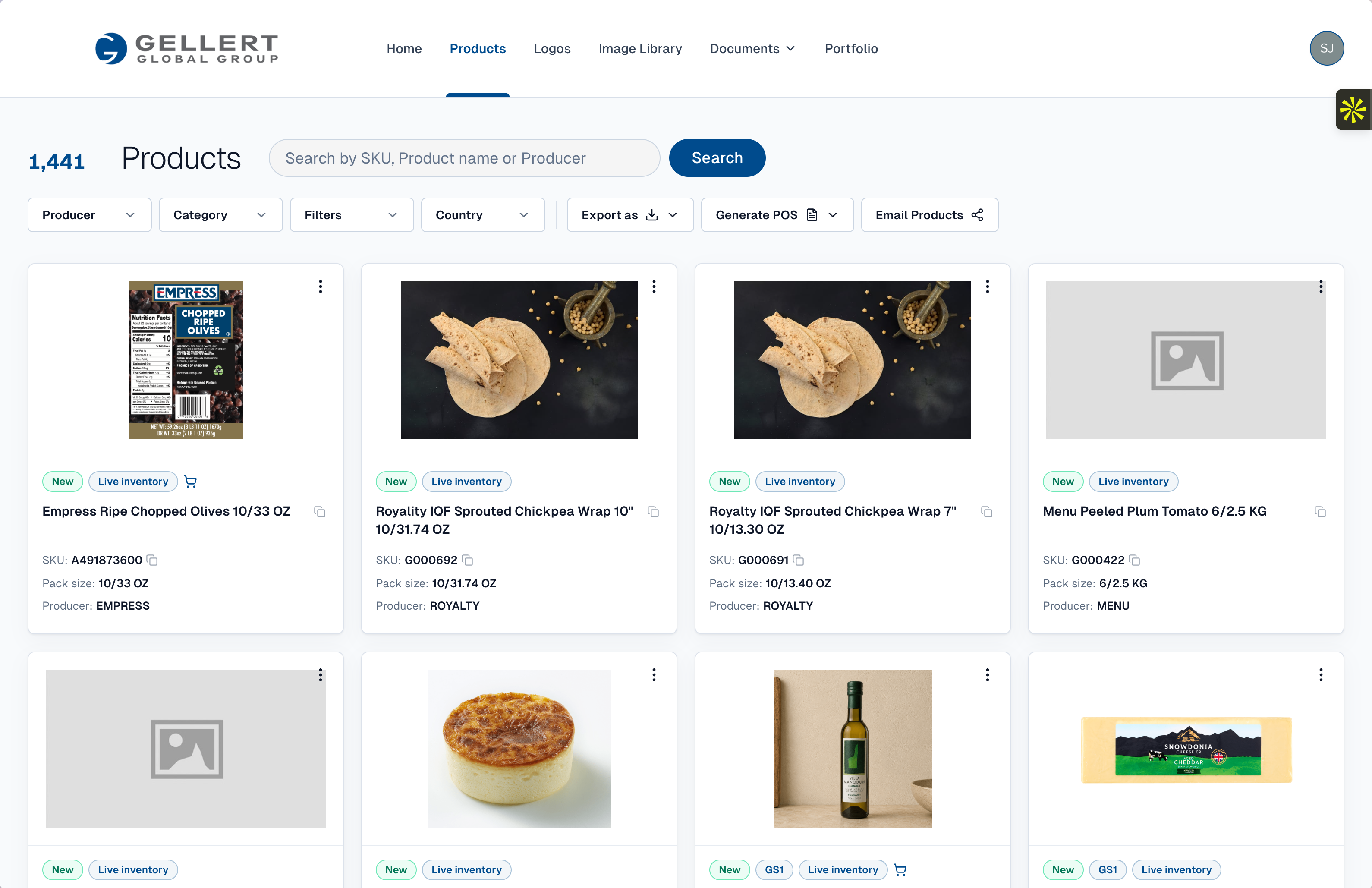

Custom platform — Gellert Global Group
Custom product platform built for Gellert Global Group
Discover the hidden costs of poor product information.

Our whitepaper on what fragmented data costs a multi-division operation, and what it takes to fix.

Download whitepaper

Bring us the problem nobody wants to own

A first conversation is a working session, not a pitch: your systems on a whiteboard, the manual steps between them, and an honest read on what is worth building.

Let's talk See our work
18 years building technology for complex operations